Showing posts with label digital puppetry hardware. Show all posts
Showing posts with label digital puppetry hardware. Show all posts
Tuesday, January 28, 2014
Henson Digital Puppetry Studio
This is a brand new promotional reel for the Henson Digital Puppetry Studio, the patented real-time animation/digital puppetry system developed by Jim Henson's Creature Shop.

Friday, February 22, 2013
Digital Puppetry with the PS4
Earlier this week game development studio Media Molecule gave a R&D presentation at the launch event for Sony's new PlayStation 4 (PS4) video game console, which appears to have some amazing new capabilities like the ability to sculpt, create and animate in real time that offer phenomenal potential for digital puppetry applications. Media Molecule won't too much about what they're working on (yet), but their demo utilizing the PS4 and the often-derided PlayStation Move controller looks amazing (skip ahead to the 5:15 mark to see all the digital puppetry goodness).
Very exciting!
Via Puppeteers Unite.
Friday, August 17, 2012
How to make your own Waldo
Ever wanted to create your own Waldo-like control and perform real-time digital characters? Friedrich Kirchner demonstrates how it's done using an arduino microcontroller, sensors, buttons and his free Moviesandbox software.
Tuesday, January 17, 2012
SoftKinetic Digital Puppetry Demo
SoftKinetic used a digital puppetry demo to show off some new firmware for their DepthSense cameras at last week's CES 2012 trade show. It highlights their new support for finger recognition, something that's difficult to accomplish with the X-Box Kinect without a lot of hacking. The firmware is still in the alpha stage, but it looks like SoftKinetic is putting together a gesture recognition system that could be really useful for digital puppetry applications.
Via The Verge.
Thursday, February 24, 2011
Chris O’Shea's Little Magic Stories
The more artists explore new frontiers in interactive art, the more I often mind myself wondering where exactly to draw the line between what is animation and what is puppetry. A good example of this is the augmented shadow puppetry that I recently wrote about over at PuppetVision, which is sort of shadow puppetry, but also sort of not.
Another good example is this performance system created by Chris O’Shea called Little Magic Stories. It was made using the X-Box Kinect (see previous post) and the old Pepper's Ghost Vaudeville trick.
So is this animation? Digital puppetry? Or something else entirely?
Via CrunchGear.
Tuesday, February 08, 2011
The N-Controller Avenger
The N-Controller Avenger is a clip-on product for standard X-Box controllers "designed for harcore gamers who want to take their abilities to the next level." Essentially, it's a casing that fits over a regular controller so that you can keep your thumbs on the controller's analog sticks while simultaneously having all of the buttons within reach. You can see more videos of it in action on the Avenger Controller website.
Although I'm admittedly not a hardcore gamer, the N-Controller seems a bit like overkill for most video games to me, but I do wonder about it's potential for digital puppetry applications. I've tried doing digital puppetry with game pads in the past and never liked it. At just $40 each I'm tempted to order one of these and try it out to see if it's useful.
Via Joystiq.
Saturday, November 20, 2010
Kinect Interactive Puppet
Long (very long) time no post here...I've been very excited about the new Kinect for Xbox 360, which seems to offer all kinds of interesting possibilities for digital puppetry, especially since it's already been hacked.
Two designers, Emily Gobeille and Theo Watson, have whipped up this digital puppet prototype with it. It's a 2D puppet that uses skeleton tracking on an arm to control the movement and posture of the puppet. They hacked it together in a day using open-source Kinect drivers, which is pretty cool.
I think we'll see a lot more stuff like this using the Kinect very, very soon.
Monday, November 26, 2007
Track Fingers With The Wiimote
Here's another potentially cool user interface for creating digital puppetry and Machinima...Johnny Lee at Carnegie Mellon University has worked out a method for tracking his fingers using the Wiimote's infrared camera. The basic idea is very similar to the iPhone and the Gesturetek technology I wrote about back in March.
Via MAKE.
Tuesday, November 20, 2007
Virtual Puppeteer Goes In To The Dragon's Den
Virtual Puppet, a UK company that "specializes in motion capture technologies and involves itself with the production of advertising, face to face experiential marketing and performance for theatre and live interactive television," was featured this past weekend on the British edition of Dragon's Den. For those unfamiliar with the show, the idea behind Dragon's Den is that entrepreneurs pitch their ideas to secure investment from a panel of business experts and self-made millionaires ("The Dragons"). The rules of the show stipulate that an entrepreneur must secure all of the financing they request from one or more Dragons or they go home with nothing. Virtual Puppet's Creative Director David Field appeared on the show to pitch the Dragons for £200,000 (roughly $410,000 US).
Virtual Puppet performs digital puppets at trade shows and retail locations using Alias' MotionBuilder software and the Gypsy motion capture system manufactured by Animazoo. You can see some examples of Virtual Puppet at work in the video above.
Wondering how David made out? Find out for yourself this clip from the show (sorry, but IE on a Windows machine required to view the clip).
Friday, June 29, 2007
Nintendo to Launch Indie Game Development For the Wii

GigaOM reports that Nintendo wants to open up the Wii platform to indie developers next year. Dubbed "Wii Ware", this new service will be designed to enable developers to create small, downloadable games for the Wii in a manner similar to Microsoft's XNA Game Studio for the XBox 360. Considering the Wii's motion-control capability I think this is great news for digital puppetry and suggests all kinds of exciting developments could be on the horizon. It's really great to see Nintendo embracing the potential of user generated content.
Thanks to Brian for the heads up about this!
Friday, March 02, 2007
Wii Power Glove Controller
A little over year ago I was speculating about using the old NES Power Glove to perform digital puppetry. I haven't heard of anyone doing that just yet, but someone in Japan has hacked together a custom controller using the Wii remote and an old NES Powerglove. The modded glove has specially mounted triggers on the thumb and middle finger to simulate the A and B buttons and an opening for the wii attachment in the back. It seems to work really well, you can see it in action in the clip above. More pics and details are available at Slash Gear.
The obvious digital puppetry application for this would be to make Machinima on the Wii and since so many people have already hacked the Wii remote to use it on their PCs, with a little technical know-how you could really start to have some fun with this thing.
Thursday, August 31, 2006
Digital puppetry on the X-Box?
Microsoft announced yesterday that XNA Game Studio Express, which lets aspiring developers work towards creating Xbox 360 games, is available for download on the XNA development environment home page. At the moment the software is beta and it will only let developers build Windows binaries, but Microsoft is promising that games can be migrated to the 360 console by Christmas (more info is available at Playfuls.com).
Of course when I heard this I immediately thought about how cool would it be to have someone develop a digital puppetry platform using the X-Box 360? Recently Atari founder Nolan Bushnell gave a speech to the video game industry and said "I believe that in the next five years, there will be a movie that will make over $100 million that will be made by three people" (sorry, I can't find a relevant link for proper attribution).
I think he's right and considering what a fantastic console the X-Box 360 is if you don't need to know C++ to make software for the X-Box and Microsoft does this right, things could get very interesting for Machinima and digital puppetry very fast.
Thanks to C.B. for the heads-up about this!
Of course when I heard this I immediately thought about how cool would it be to have someone develop a digital puppetry platform using the X-Box 360? Recently Atari founder Nolan Bushnell gave a speech to the video game industry and said "I believe that in the next five years, there will be a movie that will make over $100 million that will be made by three people" (sorry, I can't find a relevant link for proper attribution).
I think he's right and considering what a fantastic console the X-Box 360 is if you don't need to know C++ to make software for the X-Box and Microsoft does this right, things could get very interesting for Machinima and digital puppetry very fast.
Thanks to C.B. for the heads-up about this!
Thursday, May 11, 2006
Nintendo wii = digital puppetry machine?
While the debate continues to rage over wii the Friday, January 27, 2006
Digital Puppetry Hardware, part 3: The P5 Glove

The P5 Glove by Alliance Distributors offers fantastic potential for digital puppetry at a low, low price.
In my last post I wrote about the Nintendo Power Glove, the legendary but not-quite-so-revolutionary controller for the NES. Assuming that some kind of similar and relatively affordable dataglove would be a necessary part of any widely accessible digital puppetry system, I set out about a month ago to locate one and found the P5 Glove, a cheap (usually $65 or less retail) computer peripheral that uses bend sensors and remote tracking to allow users to intuitively interact with 3D and virtual environments.
I haven't actually gotten my hands on one of these yet, but the consensus from the online reviews that I've read is that the P5 is a very good product, especially for it's price range. In fact, it's probably the best glove ever designed at such a low price point. Its only drawbacks are that (like the Nintendo Power Glove before it) the P5's motion tracking is line-of-sight and there are indications that its bend sensors may be somewhat limited. I think the biggest problem with the P5 may be that the lack of games or applications available for it has meant it's gotten a lukewarm reception in the marketplace so far. This makes me doubt that future generations of the product will be produced and it could be discontinued altogether.
But problems aside, the P5 has a lot of potential. A strong developer community has sprung up around it and it's been hacked for use in everything from music to robotics. For those of you who are technically inclined, here's some interesting links for developing applications for the P5:
- Disassembling the P5 - an article that "looks inside" the P5 and its tower
- P5 Specs - From manufacturer Alliance Distributors (formerly Essential Reality)
- P5 SDKs - P5 Glove software development kits for Windows and Linux
But even if the P5 Glove is a nice consumer-grade control device for digital puppetry, there's still a need for a better, high-performance solution for professional applications.
The results of the search for that will be the subject of my next post...
Tuesday, January 24, 2006
Digital puppetry hardware, part two: The Nintendo Power Glove
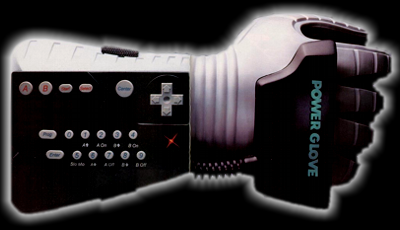
Remember the Nintendo Power Glove?
The Power Glove was supposed to spark a revolution and forever change the way video games were played, but it didn't. Mostly because it sucked. It didn't work very well and when it did all it was really good for was playing a few rounds of Punch Out for novelty value, after which you'd switch back to the regular NES controller because it was better designed and easier to use.
Even though the Power Glove never really worked, it did look incredibly cool in this TV commercial. I remember seeing that when I was about 13 and immediately thinking about how cool it would be to be able to one day use something like it to perform a digital puppet like Waldo C. Graphic on The Jim Henson Hour. Lots of other more knowledgeable people saw it's potential too and it was first hacked for doing virtual reality on the PC in the early `90s. Nowadays Power Glove-like input and control devices are called data gloves and they're used for everything from creating music to performing medical procedures.
And I still think it would be cool to use something like this to control digital puppets.
To be continued...
Thursday, January 12, 2006
Virtual Shadow Puppetry
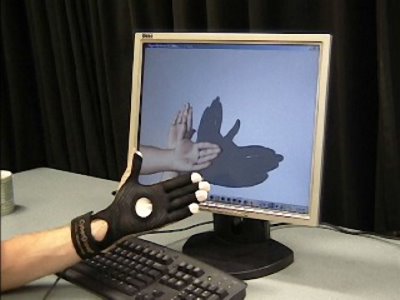
UBC alumni Paul Kry experiments with some virtual shadow puppetry.
UBC Computer Science grad Paul Kry seems to have done some interesting research in to problems surrounding modelling and animating human hands via motion capture for his PhD thesis, including some experiments with creating virtual shadow puppets in a 3D environment. Click here for a video, but be warned that it's a 33.7 mb avi file and a bit of a beast to download.
Friday, December 02, 2005
Digital puppetry hardware, part one
Brian mentioned Panda Puppet and Flash Puppet in his blog yesterday and made the excellent point that there's a desperate need for both better software and hardware for digital puppetry systems.
Unfortunately, as Brian also pointed out, almost all of the decent hardware is custom-built and proprietary. Here's a run down of what a few of the better shops in L.A. use:
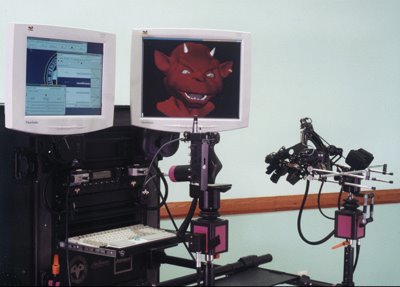
Jim Henson's Creature Shop - Has the proprietary Henson Digital Performance System, inspired by the Creature Shop's Academy Award winning animatronic controls and probably the most sophisicated system of it's kind in the world. I know a few people who saw a demo of the latest version of it in the fall and they say that it's very, very impressive.
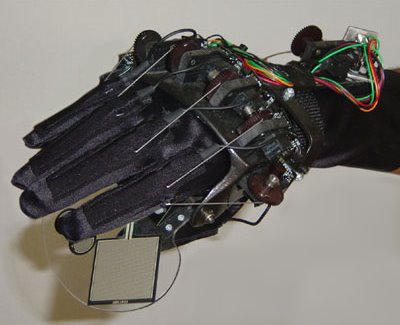
Perform FX - This company - founded by Henson alumni Dave Barclay and Bruce Lanoil - uses a neat little toy called the PerformFX Glove. I don't know much about it, but it certainly does look cool and given Dave's track record it's probably an awesome tool to work with.
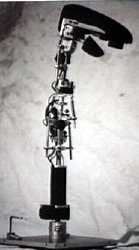 The Character Shop - Uses Waldos and owns the Waldo trademark ("Waldo" was common name for these types of devices until TCS trademarked it so no one else could use it...don't even get me started on that bulls--t). They have a whole variety of devices like the one on the right, primarily developed for controlling animatronics, but presumably they could be used for digital puppetry applications as well.
One of the interesting things that all three of these systems have in common is that they're all telemetric data input devices, not motion capture technologies (which are much, much more difficult to work with).
There's bound to be other systems like these out there. Anyone know of some that I've missed?
Unfortunately, as Brian also pointed out, almost all of the decent hardware is custom-built and proprietary. Here's a run down of what a few of the better shops in L.A. use:
Jim Henson's Creature Shop - Has the proprietary Henson Digital Performance System, inspired by the Creature Shop's Academy Award winning animatronic controls and probably the most sophisicated system of it's kind in the world. I know a few people who saw a demo of the latest version of it in the fall and they say that it's very, very impressive.
Perform FX - This company - founded by Henson alumni Dave Barclay and Bruce Lanoil - uses a neat little toy called the PerformFX Glove. I don't know much about it, but it certainly does look cool and given Dave's track record it's probably an awesome tool to work with.
 The Character Shop - Uses Waldos and owns the Waldo trademark ("Waldo" was common name for these types of devices until TCS trademarked it so no one else could use it...don't even get me started on that bulls--t). They have a whole variety of devices like the one on the right, primarily developed for controlling animatronics, but presumably they could be used for digital puppetry applications as well.
One of the interesting things that all three of these systems have in common is that they're all telemetric data input devices, not motion capture technologies (which are much, much more difficult to work with).
There's bound to be other systems like these out there. Anyone know of some that I've missed?
Subscribe to:
Posts (Atom)