There's an interesting article on India's Deccan Herald website about King Kong, Andy Serkis and whether or not he should be eligible for an Oscar for his role in the giant ape's astonishing performance. I think most people agree that Andy was robbed when the Oscars failed to acknowledge his work in Lord of the Rings. Certainly Andy isn't the only one responsible for bringing Kong or Gollum to life - the performance is built by a team of artists and animators - but how is that different from actors working with hair stylists and costume designers? Is this acting? Puppetry? Something else entirely?
These are questions that the Academy of Motion Pictures Arts and Sciences is going to have to tackle eventually.
Monday, December 26, 2005

Saturday, December 17, 2005
Democratizing Machinima
Paul Marino has an interesting post over at his Thinking Machinima blog about The French Democracy (see previous post) and the possibility of game companies censoring Machinima.
To me, this just highlights the need for Machinima tools that are independent of proprietary games and game engines. The Achilles heel of the art form at the moment is the fact that most Machinima creators are using someone else's intellectual property to create their work. A situation where a games company owns the copyright on your work is a situation ripe for censorship. Paul asks if as a supplier of technology, do the games companies get to dictate the how, what and why tech is used? My answer is that if they choose to, they do have that right.
From an intellectual property standpoint, using Halo to create Red Vs. Blue is not the same as using Photoshop to create a poster. Adobe has no ownership of the creative material used in a poster, they just make and supply the tool used to create it. On the other hand, if I use Halo to create a piece of Machinima, Bungie is not only supplying the tool I am using (the video game) but also much of the creative material as well (the textures, 3D meshes, levels, etc. within the game). Even if you extensively mod them what you're doing is still comparable to what Danger Mouse did with The Grey Album - remixing someone else's work without permission. Artistically brilliant? Sure. Technically illegal? Well, that too.
Regardless of how you feel about copyright issues, if Machinima is going to continue growing and developing as an effective medium for telling original stories, there is going to have to be a Photoshop for Machinima. The only question is who is going to make it and when?
To me, this just highlights the need for Machinima tools that are independent of proprietary games and game engines. The Achilles heel of the art form at the moment is the fact that most Machinima creators are using someone else's intellectual property to create their work. A situation where a games company owns the copyright on your work is a situation ripe for censorship. Paul asks if as a supplier of technology, do the games companies get to dictate the how, what and why tech is used? My answer is that if they choose to, they do have that right.
From an intellectual property standpoint, using Halo to create Red Vs. Blue is not the same as using Photoshop to create a poster. Adobe has no ownership of the creative material used in a poster, they just make and supply the tool used to create it. On the other hand, if I use Halo to create a piece of Machinima, Bungie is not only supplying the tool I am using (the video game) but also much of the creative material as well (the textures, 3D meshes, levels, etc. within the game). Even if you extensively mod them what you're doing is still comparable to what Danger Mouse did with The Grey Album - remixing someone else's work without permission. Artistically brilliant? Sure. Technically illegal? Well, that too.
Regardless of how you feel about copyright issues, if Machinima is going to continue growing and developing as an effective medium for telling original stories, there is going to have to be a Photoshop for Machinima. The only question is who is going to make it and when?
Wednesday, December 14, 2005
New Machinima media

Two recent developments for fans of machinima...issue #7 of Machinimag is now available. You can download a PDF copy for free by clicking here.
Also new is the Machinima Podcast with discussion about the art of Machinima and its evolution, Machinima production, interviews with creators and reviews of Machinima films.
Thursday, December 08, 2005
Responsive Face

Faces made using Ken Perlin's Responsive Face
I came across an interesting virtual puppet demo today called Responsive Face that was developed by Ken Perlin at NYU. It's completely Java-based and allows you to pose a 3D face and create keyframes that can be arranged on a timeframe to automatically generate animation. The aim of the research behind it is to eventually give computer/human interfaces the ability to simulate complex human facial expression in a realistic way. I'm not sure I'd call this puppetry per se, but it is exactly the kind of interface that's needed for effective digital puppetry systems.
Also worth a look are Ken's Body Guy and Emotive Virtual Actor projects, which are both pretty neat too.
Found via Bernie DeKoven's FunLog
Monday, December 05, 2005
King Kong and the Uncanny Valley

The CG Naomi Watts in Ubisoft's new Kong Kong game for the Xbox 360 (photo © Ubisoft).
Clive Thompson has an article over at Wired about the new King Kong game for the Xbox 360 and the Uncanny Valley. Clive observed that the drawback of the new high-definition Xbox 360 is that it can create near life-like graphics, with the near part being the problem.
 The Uncanny Valley is a concept first proposed by Japanese roboticist Masahiro Mori who observed that people have a certain level of comfort and affection towards an object that is anthropomorphic (think Hello Kitty) and resembles a human without attempting to imitate one. The higher the level of anthropomorphism, the more comfortable and attractive the object will be, but once the object too closely resembles a human people feel uneasy until the object achieves perfect mimicry of a living human at which point it becomes acceptable again. If you graph this comfort level on a chart the large uncomfortable dip in the resulting curve is called "the Uncanny Valley".
Machinima is hailed as a revolution in cinema (and I think it will be) but one of the barriers to mainstream audience acceptance it's bound to hit is the Uncanny Valley. The problem is the visual aesthetic of the most popular games used to create Machinima - Quake, Half-Life, Halo, even the somewhat anthropomorphic The Sims. Although millions of gamers have grown up on it, the video game aesthetic when it comes to humans is usually ugly and creepy and that could pose a problem if you try to reach out to large, Hollywood-sized audience.
This problem isn't unique to machinima, the mainstream computer animation industry has grappled with this too, as John Martz brilliantly documented in his now-famous blog post Pixar and the Uncanny Valley. In the puppetry world, the reason I think The Muppets are much more appealing to the mass audience than traditional marionettes is mostly because the Muppets are anthropomorphic while most marionettes fall in to the dead zone of the Uncanny Valley. I don't think that it's a coincidence that Shigeru Miyamoto - creator of Super Mario Bros. and probably the most successful game designer of all time - has consistently relied on a highly stylized, anthropomorphic design approach despite the advances in computer graphics over the past twenty-five years. Miyamoto knows what works visually and what appeals to an audience and he gives it to them.
So I think that until tools to create truly realitic humans and animation in real-time are developed, the solution to this problem is to create films and series that heavily rely on anthropomorphism. I'm in the process of modeling the first character that will be used to test Panda Puppet and it will be a very anthropomorphic, low-poly model to ensure that it will be both appealing and easily rendered in real-time.
Sunday, December 04, 2005
Putting puppetry (and machinima) on the map

Just over a week ago I started a Frappr map of puppeteers and puppet builders around the world. As of this writing 92 people have signed it so far. The goal is to build the most comprehensive worldwide map of puppeteers possible, which I think will be a fantastic resource for the internet puppetry community.
If you're a puppeteer or puppet builder and haven't signed it yet, what are you waiting for?
Over the weekend I discovered a Frappr Machinima map, which has the potential to be an incredible networking tool for the Machinima community, but only has two members so far (me and Paul Marino!). How is that possible? I don't know, maybe Paul just created it, but no matter - if you make machinima please click here and put yourself on the map!
For those who don't already know, Frappr is a cool mapping and social networking tool built using Google Map's free API.
Friday, December 02, 2005
Digital puppetry hardware, part one
Brian mentioned Panda Puppet and Flash Puppet in his blog yesterday and made the excellent point that there's a desperate need for both better software and hardware for digital puppetry systems.
Unfortunately, as Brian also pointed out, almost all of the decent hardware is custom-built and proprietary. Here's a run down of what a few of the better shops in L.A. use:
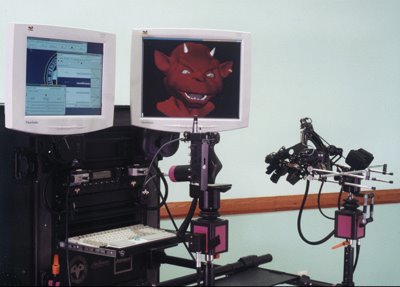
Jim Henson's Creature Shop - Has the proprietary Henson Digital Performance System, inspired by the Creature Shop's Academy Award winning animatronic controls and probably the most sophisicated system of it's kind in the world. I know a few people who saw a demo of the latest version of it in the fall and they say that it's very, very impressive.
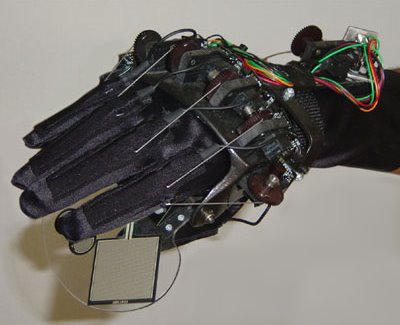
Perform FX - This company - founded by Henson alumni Dave Barclay and Bruce Lanoil - uses a neat little toy called the PerformFX Glove. I don't know much about it, but it certainly does look cool and given Dave's track record it's probably an awesome tool to work with.
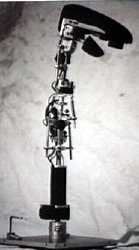 The Character Shop - Uses Waldos and owns the Waldo trademark ("Waldo" was common name for these types of devices until TCS trademarked it so no one else could use it...don't even get me started on that bulls--t). They have a whole variety of devices like the one on the right, primarily developed for controlling animatronics, but presumably they could be used for digital puppetry applications as well.
One of the interesting things that all three of these systems have in common is that they're all telemetric data input devices, not motion capture technologies (which are much, much more difficult to work with).
There's bound to be other systems like these out there. Anyone know of some that I've missed?
Unfortunately, as Brian also pointed out, almost all of the decent hardware is custom-built and proprietary. Here's a run down of what a few of the better shops in L.A. use:
Jim Henson's Creature Shop - Has the proprietary Henson Digital Performance System, inspired by the Creature Shop's Academy Award winning animatronic controls and probably the most sophisicated system of it's kind in the world. I know a few people who saw a demo of the latest version of it in the fall and they say that it's very, very impressive.
Perform FX - This company - founded by Henson alumni Dave Barclay and Bruce Lanoil - uses a neat little toy called the PerformFX Glove. I don't know much about it, but it certainly does look cool and given Dave's track record it's probably an awesome tool to work with.
 The Character Shop - Uses Waldos and owns the Waldo trademark ("Waldo" was common name for these types of devices until TCS trademarked it so no one else could use it...don't even get me started on that bulls--t). They have a whole variety of devices like the one on the right, primarily developed for controlling animatronics, but presumably they could be used for digital puppetry applications as well.
One of the interesting things that all three of these systems have in common is that they're all telemetric data input devices, not motion capture technologies (which are much, much more difficult to work with).
There's bound to be other systems like these out there. Anyone know of some that I've missed?
Subscribe to:
Posts (Atom)