Tuesday, March 27, 2007

Gameplay Boogie

Boogie
Gamers will be able to use the Wii's innovative controllers and some digital puppetry techniques to help an alien bust a move in Boogie.

EA regularly gets critiqued in the video game world for a lack of innovation. It's not hard to see why; the company seems to just churn out one relatively uninventive version of Madden Football after the other. That may finally be about to change though thanks to Boogie, one of their upcoming titles for the Wii.

On the surface Boogie sounds like another Dance Dance Revolution clone, but what makes it different is that instead of pushing buttons to make an onscreen character "dance", players have to make their character move in time with music using the Wii Remote and its Nunchuk attachment. The Nunchuk controls the character's body while the Wiimote controls its head. Players have to invent moves and dance routines with minimal guidance from the game and they succeed based on the variety of their moves and how "stylish" they are.

Sounds suspiciously like a digital puppetry game, doesn't it?

Friday, March 23, 2007

James Cameron Talks Avatar

Businessweek posted an interview with James Cameron today. In it he talks about his new in-production movie Avatar, which will be utilizing a brand new motion capture-based, real-time animation system that Cameron has been developing for a few years. Interesting stuff.

Via CinemaTech.

Cool Real-Time Rube Goldberg Device


A physics engine is a type of computer program used in video games and real-time animation to simulate different aspects of real-world physics like gravity, mass, velocity, and friction. A relatively new and fairly powerful physics engine called Bullet is being used in the latest version of Blender and to help promote its capabilities a Rube Goldberg Device contest was recently held with Blender users modeling elaborate machines using Bullet's Rigid Body physics.

You can see all of the entries here, but my favourite by far is the one above by Chris Plush, who's better known in Blender circles as "Blengine". When you watch this remember that the animation is generated in real-time. Don't believe me? If you have Blender on your computer you can download Chris' entry (link goes directly to a .blend file) and see it in real-time for yourself.

Now while this is real-time animation it's really more of a physics simulation than an example of digital puppetry. Although you can do some really basic things using Bullet's Ragdoll Physics, decent character control isn't yet possible with Bullet. It is on the developer's to-do list though and once it's implemented I think all sorts of new and interesting possibilities will open up.

Wednesday, March 21, 2007

Do-It-Yourself Cintiq Display


I have to look in to building a dedicated digital puppetry workstation for work which has me thinking about all sorts of possibilities for controllers and input devices. One thing I would absolutely love to incorporate is a Cintiq. If you aren't familiar with these, Cintiqs are hybrid monitors/graphics tablets that allow you to "draw" on a screen and interact with a computer using a stylus. I think this is a much more elegant interface for a production environment than having puppeteers fiddle with a keyboard and mouse while they are putting together a performance. There's only one problem - money. The Cintiq costs about $2,500 US which is a difficult cost to justify for a somewhat unnecessary (albeit very nice) peripheral.

Luckily, the underlying technology in the Cintiq isn't new or terribly expensive, you just have to know how to put it together and of course some enterprising artist has already built their own Cintiq for roughly $150 US. The preceding link goes to their build log and you can watch a video of it in action above. It looks pretty nice!

This is slightly beyond my current level of electronics experience, but I just may try building one as an experiment if I can round up the necessary parts.

Tuesday, March 20, 2007

Further Blurring The Line Between Animation and Puppetry

One of the interesting things I've discovered while discussing some of the concepts I am working on with Panda Puppet is that the idea of digital puppetry or utilizing puppetry techniques in animation seems to get a much warmer reception from most animators than motion capture, which has been the subject of fierce discussion and debate lately. Personally, I think the fuss over motion capture has been much ado about nothing and there are lots of ways that all these different techniques can co-exist and be used in tandem with another.

As an example, animator Michael Duffy read about Panda Puppet over at Keith Lango's blog on the weekend and pointed me to Timothy Albee's Facial Animation, a plug-in for Lightwave that allows animators to do lip sync in real-time and includes a somewhat limited 'puppeteering' mode. I don't know how useful it would be for real-time performances, but it's interesting to see another example of someone blurring the lines between puppetry and animation. You can read more about the software here. A free demo can be found at the link above along with some videos showing it in action.

Friday, March 16, 2007

First Look At Clone Wars

Yoda
A first look at Yoda, from the new Star Wars: Clone Wars television series.

This picture of Yoda was recently unveiled by StarWars.com. It's the first official image that has been released from Lucasfilm's upcoming animated Clone Wars TV series. The show reportedly makes extensive use of Zviz, ILM's new proprietary Machinima/real-time animation system.

Via Flooby Nooby.

Wednesday, March 14, 2007

Panda Puppet: Head Control Test #3


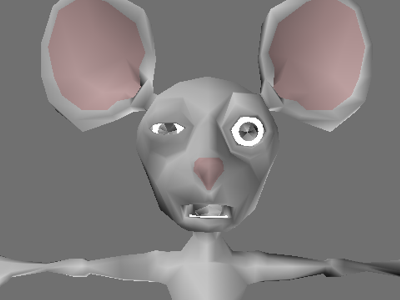
Another Panda Puppet head control test; this time I wanted to experiment by mapping controls to a pre-existing character rigged for conventional animation so I used a fun looking mouse character created by a Blender user named "Clean3D" (the original mouse rig can be downloaded here). In the video I first demonstrate some very basic actions and then show how they can be mixed together to create different types of movements and expressions. I couldn't get as much control out of the rig as I would have liked, simply because the way it was build isn't ideal for Panda Puppet, but it still turned out pretty well.

Mouse rendered using real-time graphics

Of course these real-time graphics leave something to be desired. I am still working on the programming that will record real-time performances to Blender animation, but here's what a final render of the real-time frame above would look like:

Final Mouse render

Not too bad. Thanks again to Clean3D for the great Mouse rig!